Understanding Assisted Reproductive Technology (ART): A Complete Guide

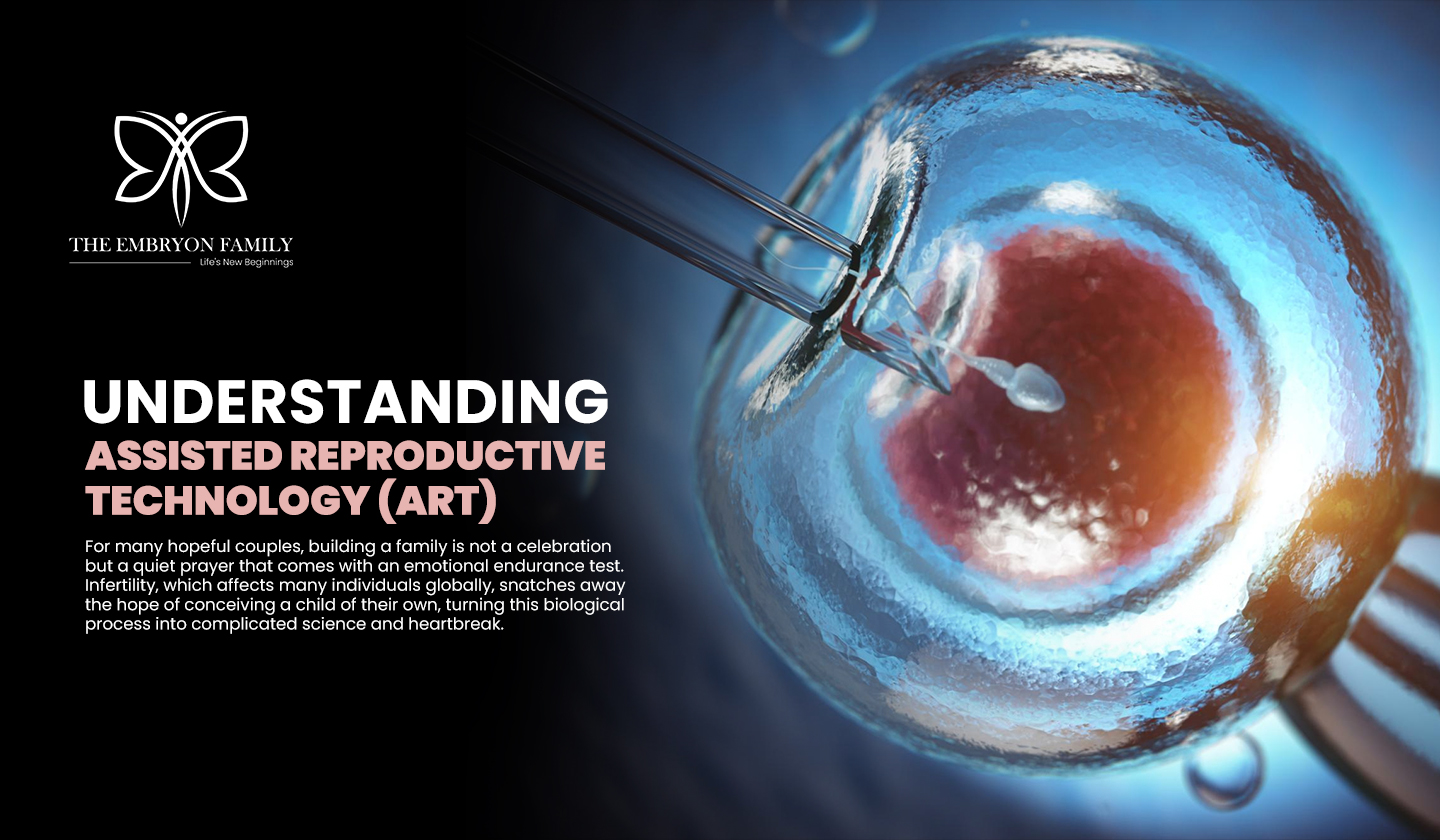
For many hopeful couples, building a family is not a celebration but a quiet prayer that comes with an emotional endurance test. Infertility, which affects many individuals globally, snatches away the hope of conceiving a child of their own, turning this biological process into complicated science and heartbreak. But that's where innovation, science, and doctors …

Assisted Reproductive Technology (ART)

Share

For many hopeful couples, building a family is not a celebration but a quiet prayer that comes with an emotional endurance test. Infertility, which affects many individuals globally, snatches away the hope of conceiving a child of their own, turning this biological process into complicated science and heartbreak.

But that’s where innovation, science, and doctors meet to shift the sad narrative into a happy one. One such way is using assisted reproductive technology methods that manually handle human eggs and sperm in a sterile environment, turning hopes into possibilities. Here mature eggs are removed surgically from ovaries to combine with sperm in a lab to transfer back into the womb in the form of ovaries. Thus, effectively opening a happy chapter for human conception.

What Is Assisted Reproductive Technology (ART)?

Assisted reproductive technology is a fertility treatment executed in a medical center to help couples facing fertility issues to achieve successful pregnancy. These fertility centers are equipped with advanced laboratories, reproductive endocrinologists, embryologists, fertility nurses, and guidance to achieve better success rates. So, when you are visiting a fertility center, you will be asked for some blood tests, fertility evaluations, reproductive health checkups, and other processes to determine which types of assisted reproductive technology treatments will suit you the best. Everything is done in highly controlled laboratories and sterile environments that can handle embryos and gametes delicately. So, it’s important to find the right clinic for this process and for achieving a successful outcome.

What Are Different Types of Assisted Reproductive Technology?

When you are seeking fertility treatments, you come across different types of assisted reproductive technology. Each of these processes is designed to address a specific concern or to fight reproductive challenges that obstruct biological processes.

1. In vitro fertilization (IVF)

The first one is the most common and heard assisted reproductive technology treatment patients consider to have a baby. In this, a woman’s ovaries are stimulated to produce multiple eggs, and then those eggs are returned to fertilize them with sperm in a lab environment. The healthiest blastocyst is then transferred into the uterus.

2. Intracytoplasmic sperm injection (ICSI)

The second type of assisted reproductive technology treatment is a specialized one to treat male fertility issues. There is no natural penetration or mixing of eggs or sperms in a dish. But a fertility expert will inject a healthy sperm directly into a mature egg to increase the fertilization speed.

  • Collection – This needle helps in sucking out the fluid-filled follicles that have the mature eggs.

3. Insemination and fertilization

  • Preparation – Both the collected mature eggs and semen are cleaned and isolated in a lab environment.
  • Selection – An expert embryologist will then pick one amongst different types of assisted reproductive technology to combine these samples. It can be standard IVF or ICSI.
  • Combination—Lastly, both these samples are fertilized in one place.

4. Embryo Culture

  • Incubation – Then these fertilized eggs grow and divide inside highly monitored chambers.
  • Monitoring – The fertilized eggs are checked and monitored for 3 to 5 days.
  • Selection – The healthiest blastocysts amongst them are chosen for transfer.

5. Embryo Transfer

  • Catheter insertion – For transferring the healthiest blastocysts, a thin flexible tube is inserted through the cervix.
  • Placement – The right embryos are deposited in the uterus directly.
  • ImplantationAfter embryo transfer, it takes around two weeks to confirm successful pregnancy.

Comparison Between Different Types of Assisted Reproductive Technology

If you want to understand different types of assisted reproductive technology, this table highlights major types that vary according to fertilization location and medical considerations.

Technology Type

Where Fertilisation Occurs

Primary Clinical Indications

In Vitro Fertilisation (IVF)

Outside the body (Lab dish)

Blocked tubes, endometriosis, unexplained infertility

Intracytoplasmic Sperm Injection (ICSI)

Outside the body (Direct injection)

Low sperm count, poor sperm motility, severe male factors

Gamete Intrafallopian Transfer (GIFT)

Inside the fallopian tubes

Unexplained infertility, religious preferences against lab fertilization

Zygote Intrafallopian Transfer (ZIFT)

Outside the body (Lab dish)

Severe male infertility paired with healthy fallopian tubes

What Are the Risk Factors and Success Rate of ART?

Every medical procedure requires a careful consideration to determine the success rate and issues revolving around health. Assisted reproductive technology comes with many perks as well as risks.

Primary Factors That Influence the Success Rate

  • Maternal age — The quality of eggs decreases with women’s age, making this a crucial factor that determines the success rate.
  • Cause of infertility — Some fertility problems can be due to poor reproductive health, but it can be easily bypassed in a lab environment.
  • Lifestyle habits — Smoking, chronic stress, use of drugs, and higher BMI can impact the treatment results.
  • Lab standards and protocols — Make sure to choose a reputable laboratory for clinical trials, as it plays a major role in success rate.

Potential Risks and Side Effects of This Process

There are many risks and side effects of this procedure, so consult the specialist before deciding anything.

  • Multiple pregnancies — If there is more than one embryo, then this increases the chances of triplets or twins having their own risks.
  • Ovarian hyperstimulation syndrome (OHSS) — Injecting fertility medicines and undergoing treatments can cause painful and swollen ovaries, which is rare.
  • Ectopic pregnancy — There is also a risk of embryo implantation outside the uterus or fallopian tube.

Conclusion

Fertility comes with a wide variety of challenges and rarely a straight line. It is a difficult journey that is paved with resilience, patience, and ultimate vulnerability. Biological science is not a magic trick but a protective environment that nurtures and provides a perfect condition to thrive. By using the embryon family advanced lab techniques and medical precision, one can easily overcome issues like infertility. Technologies such as ART or assisted reproductive technology can offer couples a chance to grow their future families and a hope to build a home.

FAQ

What is the full form of ART in medical terms?

ART, or assisted reproductive technology, covers all types of fertility treatments that source and match eggs with sperm outside the natural human being.

Some of the basic things you need to consider while choosing a fertility center are evaluating their success rate, knowing about their experienced specialists, and seeing if they adhere to verified embryology lab standards for all types of assisted reproductive technology sessions.

There are multiple risks involved with ART. Treatments that need to be consulted with an expert, such as ectopic pregnancies, mild cramping, excessive bleeding, ovarian hyperstimulation syndrome, and even multiple births.

There are many factors that help a doctor decide between different reproductive techniques, such as medical evaluation, ovarian reserve screens, uterine ultrasound, semen analysis, or blood tests.

No, intrauterine insemination isn’t included in clinical trials because in this process eggs are handled in a woman’s body, which is a natural environment and never done in labs.

Ira Nissel

Ira Nissel

Ira Nissel, the Founder and CEO of The Embryon Family, is a native New Yorker currently residing in Kyiv, Ukraine, where he guides couples and single women on their journey to parenthood. Read his story...
Table of Contents
Share
Ira Nissel

Ira Nissel

Ira Nissel, the Founder and CEO of The Embryon Family, is a native New Yorker currently residing in Kyiv, Ukraine, where he guides couples and single women on their journey to parenthood. Read his story...
Share

Leave a Reply

Your email address will not be published. Required fields are marked *

error: Content is protected !!